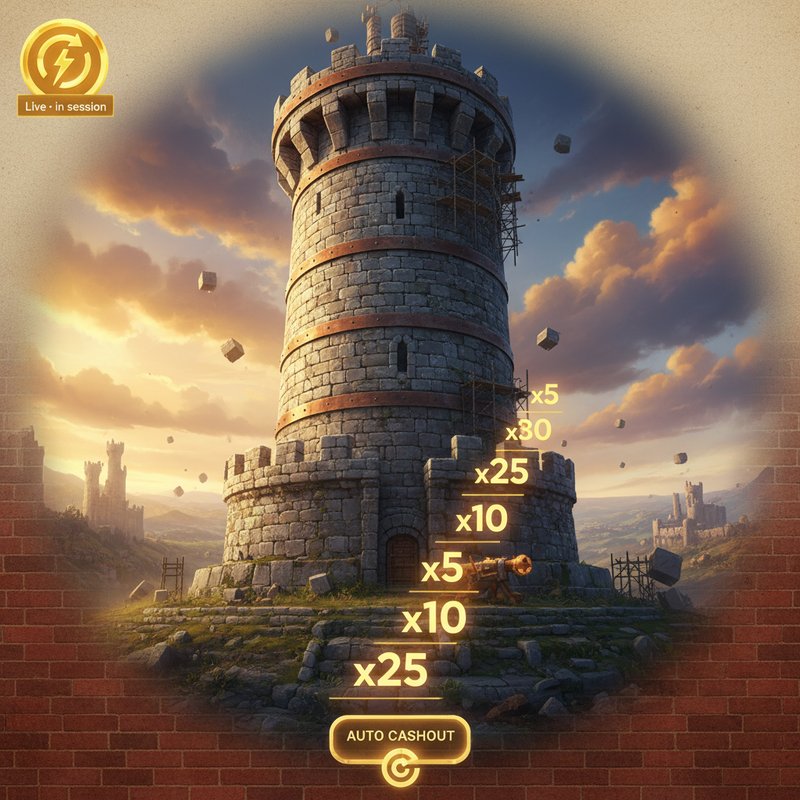
Most crash games are abstraction: a plane, a rocket, a curve climbing on a chart. Galaxsys took the same maths and tied it to something you can actually feel — a tower that gets visibly heavier, less stable, more reluctant. The multiplier becomes a thing of bricks and weight. When it crashes, it crashes downward, not off-screen.
That sounds like decoration. It isn't. Players who switch from Aviator or JetX to Tower Rush report better timing after a session or two, simply because the visual feedback is concrete. You start to feel when the tower is in trouble, the way you feel a chair leaning too far back.
"The maths is identical. What changes is what your body does with it."
The 97% RTP is the headline figure, and it is genuinely competitive — most slots sit between 94% and 96%. But headline RTPs are long-run averages. In any given session, the game lives in its variance. Tower Rush is moderately volatile: roughly a quarter of rounds reach x3.00, around one in ten reach x10.00, and the ceiling of x10,000 is technically reachable but a once-in-a-very-long-time event.
The dual-bet feature is where the game rewards thought. The conventional approach — small bet at x1.50, larger bet at x10.00 or higher — turns each round into two outcomes rather than one. You bank a steady drip from the first slot while letting the second hunt for outliers.
The provably fair system is worth understanding even if you never use it. Before each round, the server publishes a hashed seed. After the tower falls, the seed is revealed, and you can run the same hash on your own machine and confirm the round was decided before any bets were placed. No retroactive tinkering is possible. This is now the standard for crash games, but Galaxsys's implementation is unusually clean — the verification page is one click from the play screen.
One practical tip. The x3.00 auto-cashout is the unglamorous sweet spot. It hits often enough to keep a session alive and pays well enough to absorb the losing rounds in between. Avoid chasing x100.00 and up unless you've already locked in your floor for the night.